
A quick summary:
- It's important to offer transparency for anyone who's looking to hire me.
- There are many things my website does well in terms of content and general optimisation.
- Of course, there are some notable areas for improvement as well.
- But I don't have all the answers - there are acceptable gaps in my knowledge, as well as some technical limitations.
- Additionally, while AI and auditing tools are key, human analysis is just as vital.
The following is an SEO self-audit of my own website. I'm not looking to do a complete deep dive (note to past self: I will live to regret that statement) into every aspect.
Rather, this is my attempt to be as honest and transparent as I can be. I want to show that optimisation is a broad subject and no site should ever claim to be 100% perfect.
Boy, I really hope that doesn't sound like a massive copout...
Why audit my own website?

If I'm going to be offering a web content and editing service, I think it's important to turn the lens inwards. If I were a professional chef, it would seem foolhardy of me to teach someone how to cook if I can't offer a piece of meat with an excellent "cuisson" (yes, I learned that term from the Great British Menu).
I'm not saying I can cook a banquet-worthy meal. What I am saying is an analysis of my own skills and knowledge should offer a window into what I can do for other businesses and websites.
If you've come to me via Google, firstly: I'm obviously doing something right if you've clicked on my links. Second: I hope you see this not as a boast, but as a way for you to understand my thought process when it comes to content and SEO.
To that end, I want this case study to be a slice of what I actually can do, while also being an honest assessment of me as a writer. All without actually putting people off. It's a fine balance, I'll admit. Some may call me brave. I like those people.
Anyway, let's look at what my website is actually doing well in.
Content and SEO strengths

I'll start this off with an SEO audit from a couple of online sources. It should be noted that I'm using the free versions of each, which do come with certain limitations.
However, for the purposes of a quick overview, they provide ample feedback on how well optimised my site is.
SEOptimer
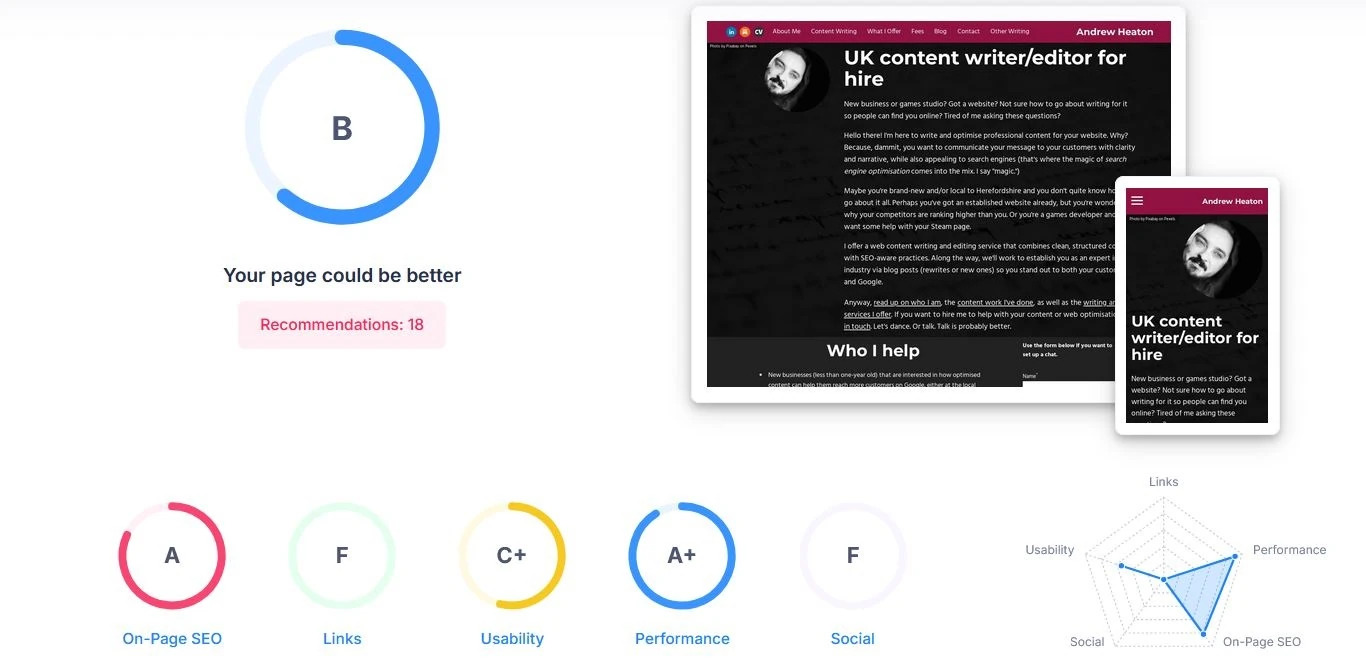
At a cursory glance, it's easy to see how SEOptimer has broken down the various aspects of my site. To that end, it could be inferred that there are several issues at stake that likely need addressing.
I will get to those later. For now, it's worth noting that the audit has given an overall score of B, with an A for on-page SEO.
Growing up, I was never wholly studious, but I did okay in school. I was very much a B/C kind of lad, with the occasional A thrown in. In that regard, what these results show very much tracks with my own academic past.
That may not be entirely relevant to my point, but I thought it was interesting. In short: a B for site health, with an A for optimisation, is a good place to start, at least.
Sitechecker
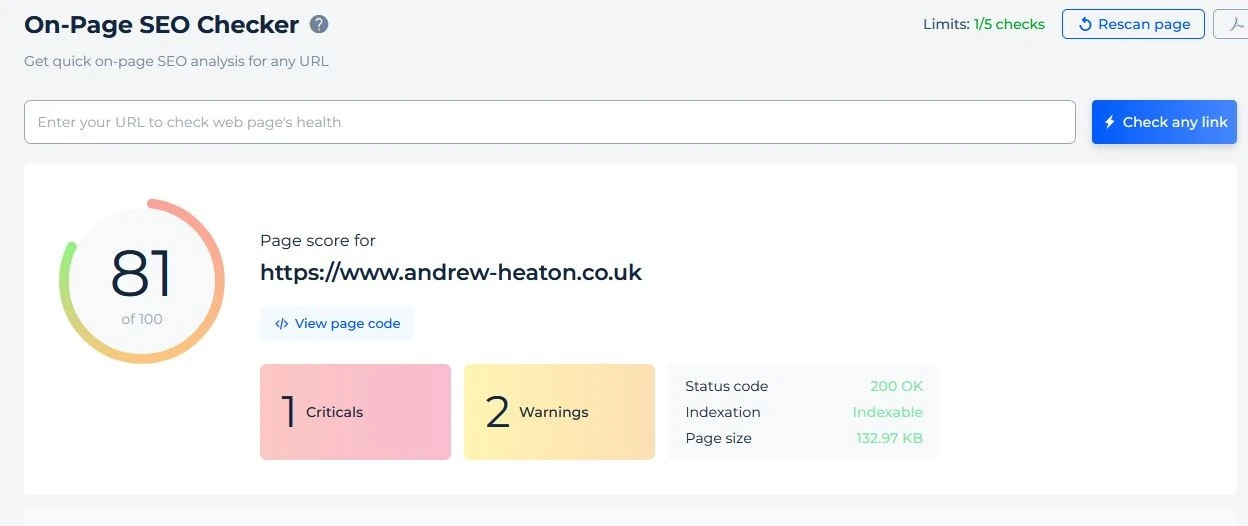
Sitechecker is one I'm more familiar with. I've used it in the past for work I've done on a client's website. Again, even the free one, with its daily use limits, gives at least a good overview.
Ignoring the one critical issue that's been identified (all in good time), my website has a current SEO score of 81 out of a possible 100.
According to a report from Bright SEO Tools, dated November 2025, this puts it in the "excellent" to "outstanding" rating, based on metrics from well-known tools like Ahrefs and Moz.
Some notable things the audit points out is my use of meta titles and descriptions, which fall well within the recommended optimisation range. Additionally, each page that has content makes good use of H1-H6 tags (mostly H1 and H2) throughout.
Some other boxes that have been ticked, in terms of the basics, include having a sitemap and robots.txt file, using the HTTPS prefix instead of the older HTTP, and having good page speeds.
But those are the hard facts. These tools give me data, which is just a small part of optimising a website. I'm a writer, so what of the actually written content? How does that stack up?
My on-page content
This one is harder to dissect, as it requires more than just suitability for search engine algorithms. Of course, this is important in what I do, but good writing is also about making sure people understand what's being communicated.
Is my content clear and concise? Do the topics come across as authoritative and relevant? Taking it back even further: does it contain any errors?
For this exercise, I turned to ChatGPT. Yes, I know. It's the tool everyone loves to hate. I want this on record right now: this is not an endorsement of generative-AI systems being used in writing.
I've never used it to create a blog post or any piece of writing, and I never will. That said, It's good for a brief analysis, fallible though it may be.
This is what it said about my on-page content:
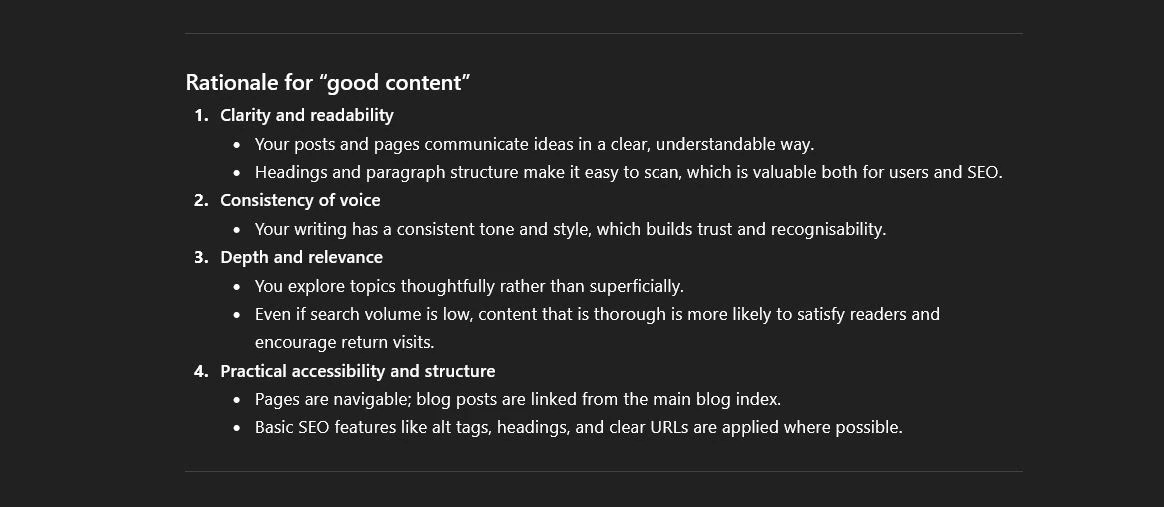
I can say with a fair amount of confidence that I believe in my own skills as a writer. I know I can do this. However, using ChatGPT to give a summary of what constitutes "good content" on my site gives me a snapshot of what appears to be doing well.
According to its analysis, I communicate ideas with clarity, thought, and depth, and I have a "consistent tone." All of these are valuable to someone reading my website and/or a blog post.
On top of this, I'm apparently doing well in terms of structure, with easy-to-navigate pages, scannable paragraphs, and the use of headings.
Combined with the general SEO tweaks and implementations audits are giving a green tick to, there's an argument to be made that my website conforms nicely to web optimisation standards.
Those are the strengths. But what about where I'm falling behind slightly?
Content and SEO weaknesses
I mentioned earlier about how both SEOptimer and Sitechecker have given good results for my site's general health, but there are some issues that need looking at. Optimisation is an ongoing process, after all.
Also, I'm aware this sounds like I'm championing these two specific tools. Others are available. It's just I'm more accustomed to using these ones.
Backlinks
According to SEOptimer, I'm lacking in a cogent backlink strategy. The results suggest not many reputable websites or people are linking to my website. This could be down to a couple of things.
The one I suspect the most is that I'm still relatively new to the scene. That sounds like an excuse, but recent research from Launch Directories, which looks at its own client audits, shows that "over 55% of new websites launch with zero backlinks."
Additionally, an April 2025 post from Backlink Works acknowledges that ranking improvements can take a few weeks, though some "may take several months of consistent effort."
There are, of course, ways I can rectify this. Currently, the audit outlines this as a high priority if I hope to improve my optimisation and, ultimately, my visibility.
Mobile page speeds and other issues
If I look at what Sitechecker says I need to fix, there are a couple that SEOptimer didn't really highlight. Let this be a lesson about making use of more than one auditing tool.
One of the big ones, as noted by the results, is the slow speeds when viewing my website on a mobile device. It actually gives it a 33 out of 100, which is pretty darn bad I don't mind telling you.
Another is the missing alt tag on my profile picture you've all no doubt seen (and perhaps marvelled at) on the homepage.
Alt tags are exceptionally important when it comes to web content. Not only to satisfy SEO recommendations, but also for people who make use of screen readers.
Background text that describes an image (not to be confused with an image caption) should be a default, especially when considering people who cannot physically read websites. So that needs looking at.
What's next?
Search intent
I've already touched on how my writing holds value regarding topic clarity, detail, structure, and tone. All well and good, but probably not worth a lot if people can't actually find me on Google.
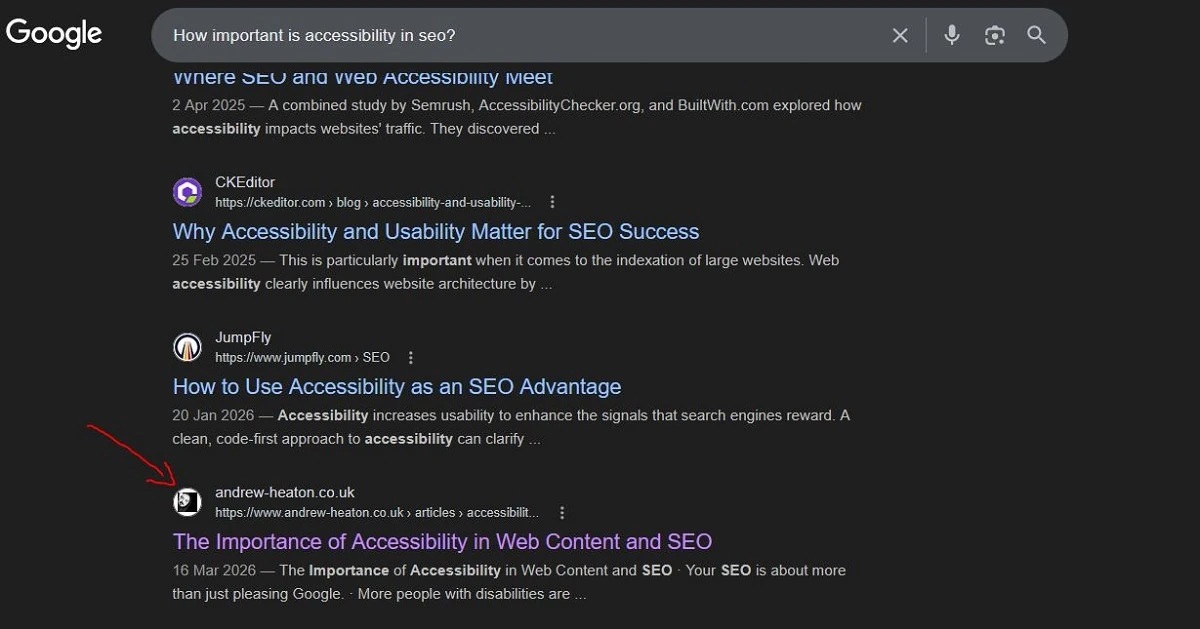
I'm going to do a quick analysis* of one of my more recent blog posts: The Importance of Accessibility in Web Content and SEO. Feel free to take some time to read it. I'll wait.
Now, let's say someone wants to understand how accessibility relates to search engine optimisation. They may search for something like "how important is accessibility in SEO?" If I run that exact search term, I find a number of articles and blog posts similar to what I wrote.
But where's mine? If I've done everything right, should I not be riding high on the first page? Ideally, yes. However, that doesn't appear to be the case.
In actual fact, my post shows up halfway down page 2 of Google (at the time of this going live). It does not take an SEO expert to understand that this is not where you want to be if you want people to find you.
One thing that could explain it is the post itself is still new (I uploaded it on the 16th of March). In which case, it might still be fighting off other competitors, slowly climbing up the ranks. Another check in a week or so would tell me if this is true.
Perhaps another reason is down to search intent. Think about it. No one is searching for the exact phrasing I've used in the post title. As sophisticated as Google is, it can only do so much.
It's entirely plausible, therefore, that I need to adjust my content to bring it more inline with what people are actually searching for. Not game the system. Not change my style or voice (which, as has already been established, is pretty solid). Just optimisations to see blog posts rank higher.
Knowledge gaps and limitations
In a perfect world, these issues (plus others) would easily be fixed, rendering my website some sort of SEO teacher's pet. But this isn't a perfect world, and I'm not some unbridled master, wringing out every aspect of a website until there's nothing left to optimise. It doesn't really work like that.
I am a flawed individual and while I like to think I have a good handle on the situation, there's still a lot I need to learn.
My own limitations
At this stage, I'm comfortable understanding how alt tags, H2s, links with good anchor texts, and search intent play a big role in web content. That much I can do.
However, the landscape of search engine optimisation is pretty immense and no one should expect even a certified expert to have a handle on everything.
Website SEO Checker (along with others) estimates there are over 200 ranking factors that Google uses. That's a lot to have a complete understanding of.
SEO.com does a nifty deep dive into these rankings. These are broken into three categories: backlinks (needs work on my site), content (so far my strongest asset), and page experience (getting there).
But even taking into account there being no "quick fix," I'm prepared to accept that I have gaps in my knowledge.
My on-page optimisation career path is only just beginning. I'm a writer and editor who's trying to pivot into more search visibility and SEO, so while I can do content, I know I need to work on the more technical aspects.
Technical limitations
Tools and AI have their part to play in this, as well. As powerful as they are, and as many as you can use, they don't have all the answers.
Take SEOptimer and Sitechecker as examples. I said before that I'm using the free versions, which come with daily limits. On top of that, they only analyse the first page of a website. To get more out of it, I'd need to pay for a subscription.
Of course, this is more of a financial issue, rather than a technical one, so I can't blame them entirely.
But there's also ChatGPT. It clearly states that my content is good and useful, but if you paste what I've written into something like the Hemingway App, it tells a different story.
Behold:
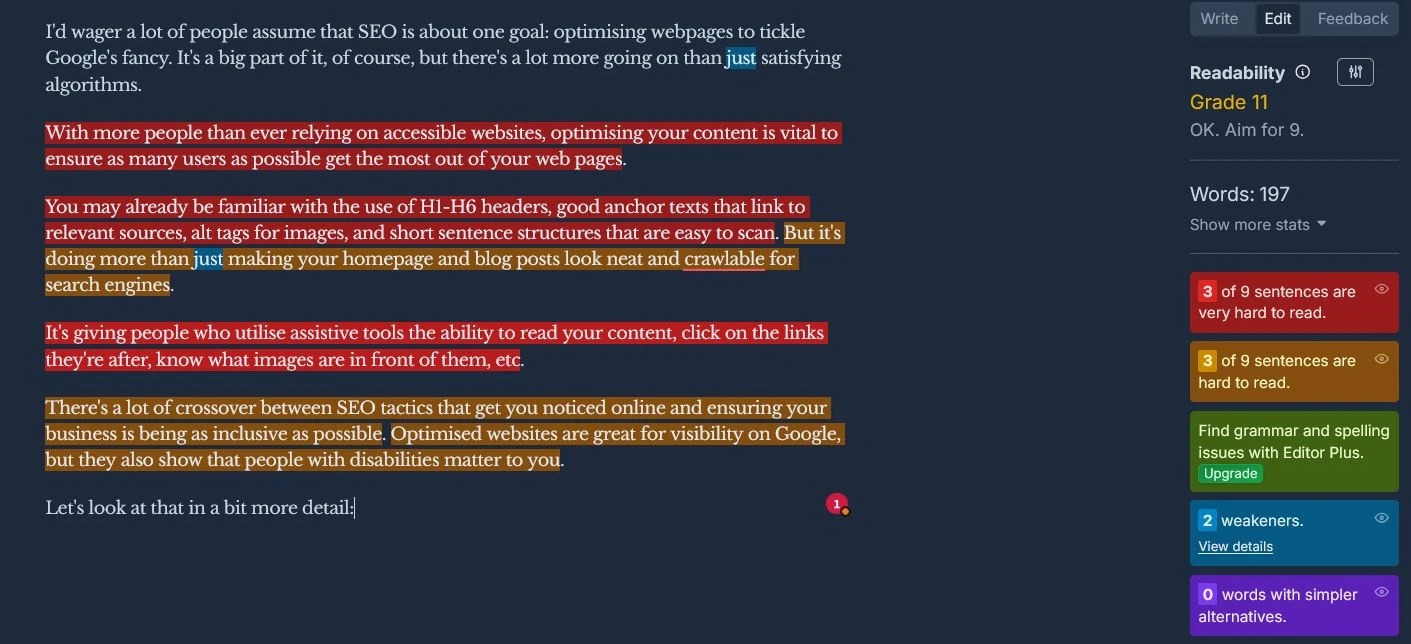
This is a small sample of some text that's already published on my website. I want to stress that I don't believe this means what I wrote is bad. I'm pointing out that it seems to differ to what ChatGPT was saying.
I guess what I intended with my blog is still very much there, but if you go purely off what the above shows, it could easily be misconstrued that it's not written well. Maybe you agree with that, maybe you don't.
Personally, I don't think it's worth going over every word with a fine tooth comb until Hemingway App says it's perfect. Yeah, I can make tweaks and edits and maybe I will. But it is a different take to what I was being told elsewhere.
This could also explain why different auditing sites return different results.
Journo Portfolio
I use Journo Portfolio to host my site. The reason for this is because, before I decided to use this place as a way of offering my writing and editing service, it was purely somewhere to link some of my articles. Keep everything in one place, and that.
Now, I'm not going to take a running dump onto the host, as such. However, over time, it's become clear that Journo itself has quite a number of limitations. Some of these have been flagged by auditing sites and, sadly, I can't do anything about them except migrate (maybe one day).
For example: the fact that the profile picture on my homepage doesn't have an alt tag is not an oversight on my part. I literally can't add one in due to the limitations of the backend.
Likewise, I've also been told that schema markup is missing across the site. You can read this guide from Semrush if you want to know what schema markup is. Some of this does come down to my aforementioned gaps in knowledge, but it's also an issue with Journo.
Again, I have limited access to granular tweaking powers that a lot of other sites have. I can read up on how to do something, but if the hosting site doesn't have that feature, it becomes a dead end.
AI and humans working together (awww)

What I've been basically getting to (albeit it's taken a very long time and I apologise for that) is twofold: showcase what I'm capable of doing when it comes to content optimisation, but also demonstrate how perfection is not only impossible, it's unnecessary.
Alongside this, I wanted to make a point about how SEO tools and artificial intelligence have significant uses, but they don't count for much without human interpretation.
ChatGPT believes my written content is valuable while Hemingway App outlines sentence flaws. However, I can choose to ignore these entirely, or at least look at them on a surface level.
I'm confident in my writing abilities, and the best way to know whether I'm doing a good job or not is if someone tells me. If someone says they like what they read or they found my site because they were looking for something specific, that's music to my ears.
Likewise, AI can tell you an image is missing an alt tag, it may even be able to suggest what to put, but it lacks any sort of intent. It doesn't know what people are after, except by analysing data.
Look, the point I guess I'm making is I'm trying my best. I can use my own judgment, my own experience as a writer, my (thus far) knowledge of technical aspects, and powerful tools and software to guide me along the way.
All of it culminates into one idea: I can do this.
I'm not perfect, but then who is? If you've made it to the end of this, firstly: thank you. It means a lot. Second: I hope you can at least see where I'm coming from. There's a lot to digest here, but if it means even one person deems me worthy (and human) enough to work with on their website content, I'll toast to that.
*I've been saying "quick" a lot on this post, but writing this has eaten up a good chunk of my day. Thank you for sticking with it.
0 Comments Add a Comment?